Ukraine war : Economics and socials consequences for Poland
PART 3
ECONOMICS AND SOCIALS CONSEQUENCES FOR POLAND
CHAPTER 8
ECONOMIC CONSEQUENCES OF THE UKRAINE WAR
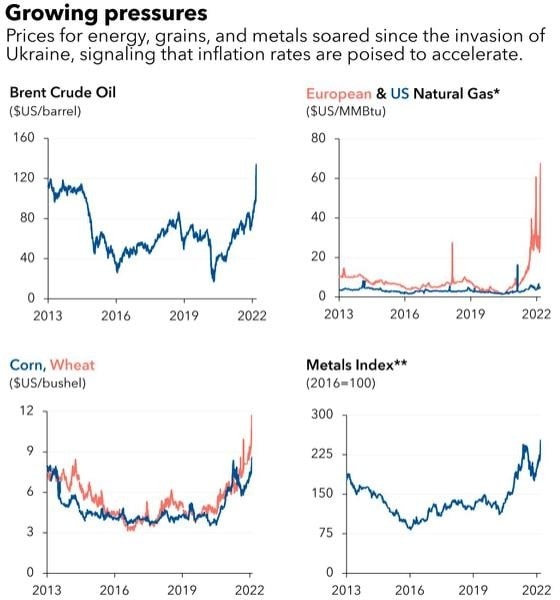
Added to the humanitarian crisis due to Russia’s invasion of Ukraine, the war has an impact on the global economy of the world, it is hurting the entire growth and rising prices, the inflation increased as well.
We attempt the impact of this war on three big points. The first one is about the higher prices for food and energy (impact on inflation). The second point is about the neighbouring economy, we will develop more about this channel.
The consequences are disrupted trade and supply chains. The third point is about the decrease of business confidence, in consequence, we can schedule a higher uncertainty from the investor, in these fragile business conditions, prices will increase. Moreover, Russia and Ukraine are major commodities producers, in terms of oil and natural gas.
It is the same about food: Ukraine and Russia represent 30% of global exports of wheat. (How War in Ukraine Is Reverberating Across World’s Regions, March 2022).
Figure 5: Consequences of the war on inflation. (How War in Ukraine Is Reverberating Across World’s Regions March 2022).
The war in Ukraine had a real impact on the Polish economy, these impacts are mainly the reduction of the growth dynamics of GDP and the increase of the prices with less availability of raw materials.
According to experts from BNP Paribas, the decline of GDP’s dynamic growth could reach 3.5%. Moreover, the increase in the prices of the raw materials, with a weaker exchange rate plus the disturbances occurring in the supply chains make provokes higher inflation.
In February 2014, Russia launched a war in Ukraine, and the reasons for this invasion are still not clear.
We can ask ourselves what motivated President Vladimir Putin to send troops into Crimea and why the conflict spread to eastern Ukraine with Russian support. (Roots of Russia’s War in Ukraine, 2015).
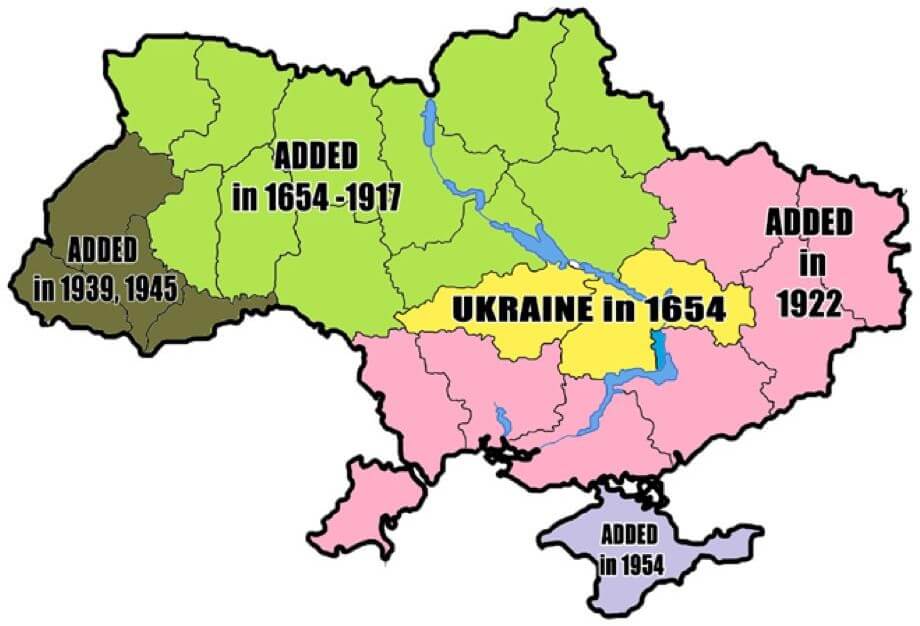
To understand the actual situation of Ukraine and the reason for the Russian invasion of this territory, we have to go back to the past.
World stability depends on the relationship between major powers. Two scenarios can be imagined: the first one is a world with a balance of power, and the second one is a world with collective security.
Since the end of the big world war and the cold war, the scenario can change, between the balance of power and collective security. It is a fragile balance.
We are going to try to explain the origins of the war in Ukraine.
To begin, it is important to note that the war in Ukraine is only a consequence of a larger conflict between two power blocs. To understand the situation, we must study the « architecture » of Europe post-Cold-war.
The two power blocs we are talking about are Europe (the Occident) and Russia.
After the cold war, the two blocs are not at an equal level in terms of security. In fact, the Occident kept NATO (The North Atlantic Treaty Organization) alive. This conservation has deteriorated the relationship of Occident with Russia. NATO continues its expansion without listening to Russia, who mentioned many disagreements with the NATO projects.
Indeed, NATO proposed to Ukraine become a new member of the organization. Moreover, the EU offered Trade and Association Agreement talks to Ukraine. As a result, the relationship between the blocks derived toward the balance of power. (The Origins of the Ukraine Crisis and the Need for Collective Security between Russia and the West, October 2016).
Now, let’s talk about the policy implications. Logically, the way how the losers of war are treated is determinative of future stability. We are here talking about the situation post-Cold-war. The Occident missed an opportunity to integrate Russia into the Euro-Atlantic security architecture (so in NATO).
To keep a security balance, the nations need to have friendly neighbours (mainly for nations within landlocked). By this way, the « friends » help to protect their country from any form of attack.
These neighbours are forming spheres of influence which can be formalized in the form of alliances. The major goal of such an alliance is to be a collective defence organisation. Thus, the aim is to defend each other, militarily, in case of an attack from another country. According to the alliances’ theory, this should deter potential enemies from attacking and therefore keep stability and security.
Any potential aggression is considered a subject of the highest importance, as a result, it can be an aggressive reaction and war. By reading these words, we can think alliances are good and permit to keep peace in the world, but the reality is another thing.
A structural problem of alliances is that they are always looking for external enemies that may compromise their territory. This process can become a « self-fulfilling prophecy ». It means that mistrust can create more mistrust, tensions, conflicts, and finally war. That’s why a bad balance can end up in war.
Ukraine and Poland : historical and modern link between
Université Grenoble (UGA)
Grenoble IAE – Gaduate school of management
Mobility Study dissertation
Licence – mobilité études Program Management 2021 – 2022 The impact of the Russian-Ukrainian war on Poland
Presented by:
FARAG Noureldin
University Advisor:
Mrs. Ludivine chaze-magnan
Host organization:
Warsaw School of Economics
Date: from 12/02/2022 to 22/06/2022
Grenoble IAE – Ecole publique de management
Grenoble INP – UGA
Disclaimer:
Grenoble IAE, University Grenoble Alpes, does not validate the opinions expressed in theses of masters in alternance candidates; these opinions are considered those of their author.
In accordance with organizations’ information confidentiality regulations, possible distribution
is under the sole responsibility of the author and cannot be done without their permission
Anti-plagiarism statement
SUMMARY
The war in Ukraine is a current topic, but it is also a problem that refers to the past. In this thesis, we will see how the war in Ukraine happened. Then we will explain the impact of this war on Poland and its operating system.
We will study the phenomenon of Ukrainian immigration to Poland and the consequences thereof. We will explain how the integration of Ukrainians took place in Poland. In addition, we will also discuss the links between Poland and Ukraine that have existed for centuries.
This thesis draws parallels between what is happening today and what happened in the past. Poland plays a major role in the handling of Ukrainian refugees; you will understand why by reading this thesis.